


In the heart of Asakusa, the Sensō-ji temple complex stands as a timeless icon. Legend traces its origins to 628 AD, and it still captivates over 30 million visitors each year. I’ve revisited the temple multiple times to help you get the most out of a single visit. This tour covers the must-sees, plus the subtle details many visitors walk right past.

1. Asakusa Tourist Center
We’ll start our tour at the Asakusa Culture Tourist Information Center. This striking wooden building was designed by renowned Japanese architect Kengo Kuma¹. Inside, you’ll find local maps and area information, occasional exhibitions, and a café, as well as a large observation terrace on the 8th floor. The lower floors close at 20:00, but the terrace remains open until 22:00.
Grab a drink from the café and step onto the terrace to get a birds-eye preview of sights you will be visiting on this tour.

Asakusa Culture Tourist Information Center
〒111-0034 Tokyo, Taito City, Kaminarimon, 2 Chome−18−9 浅草文化観光センタEssentials
Opening times
- 09:00 - 22:00 (terrace)every day
Notes
The lower floors close already at 20:00, but the terrace is open as late as 22:00.
2. Kaminarimon (the “Thunder Gate”)
After you come down from the terrace, you’ll reach Kaminarimon, the outer gate marking the entrance to Sensō-ji’s temple grounds. It’s called the “Thunder Gate” (雷門) because it’s flanked by Raijin, the thunder god (left), and Fūjin, the wind god (right).

As you pass through Kaminarimon, take a moment to look up at the giant paper lantern (chōchin). The front reads 雷門 (“Thunder Gate”), while the back displays the gate's full name, 風雷神門 (“Wind-Thunder Deity Gate”). However, most visitors miss the best detail: an elaborate dragon is carved into the underside. In East Asian tradition, dragons are closely tied to water, so this carving is often explained as a protective symbol meant to guard the gate against fire: something Kaminarimon has needed in the past, after the earlier gate was destroyed by fire in 1865. The current gate was rebuilt in 1960 using funds donated by Kōnosuke Matsushita, the founder of Matsushita Electric (now Panasonic), who prayed at Sensō-ji for his health issues and later donated towards the reconstruction of the gate upon recovery.

3. Nakamise Street
Beyond the Kaminarimon, there is a commercial area. This is in the form of a 250-metre-long shopping street. Called Nakamise-dōri, which literally translates as “shops in the middle street”, it lives up to its name, with vendors selling traditional souvenirs and historical snacks such as senbei (rice crackers) and dango dumplings. As a local speciality of Asakusa, I would suggest trying ningyō-yaki, which are small sponge cakes filled with sweet red bean paste. These cakes come in various shapes, such as the five-story Pagoda, the giant Kaminarimon lantern that you just saw, and the pigeon (feeding pigeons was considered a good merit) If you visit after 17:00, you can enjoy a hidden gallery: the lowered shutters feature beautiful paintings depicting the history and seasonal events of the Sensō-ji temple.

4. Hōzōmon (the “Treasure House Gate”)
At the end of Nakamise Street, you will find another gate: The Hōzōmon. Also known as the Treasure House Gate, it houses many Buddhist scriptures (sutras) on its upper floor. By placing these sacred texts in the gate, every visitor passes under the word of Buddha and receives blessings.
As is common at Japanese Buddhist temples, two Niō guardian statues stand guard at the entrance: Agyō, whose open mouth symbolises the beginning of the universe, and Ungyō, whose closed mouth signifies the end.
However, the Hōzōmon features another form of protection in the form of two colossal straw sandals (o-waraji) hanging from the pillars on its rear façade. Measuring 4.5 metres in length and 1.5 metres in width, each weighing 400-500 kilograms, they act as a medium of psychological warfare against the supernatural. According to superstition, if a demon were to approach the temple and see sandals of such immense size, it would assume that the guardian wearing them must be invincible and flee immediately.

5. Five-Story Pagoda
To the west of the Hōzōmon Gate stands the five-story Pagoda. Each story represents one of the five fundamental elements of Buddhist cosmology: (1) earth, (2) water, (3) fire, (4) wind and (5) sky. The topmost story houses sacred relics. The entire Pagoda is closed to the public.

6. Hondō (Main Hall)
The main attraction at Sensō-ji is the Hondō (Main Hall), also known as the Kannondō (Hall of Kannon). This hall is dedicated to the Bodhisattva Kannon, also known as the Goddess of Mercy. Before entering, be sure to stop by the incense burner in front of the building. You will see people waving the smoke over themselves, as it is believed to have healing powers. Wave the smoke towards any part of your body that hurts, or wave it over your head if you want to get smarter. I still recommend studying, though!
Now, let's head towards the Hondō. Legend has it that two brothers who were fishermen were fishing in the river right near here in 628. They pulled a golden statue out of the water. They tried to throw it back, but it kept coming back to them. That statue was the Goddess Kannon. It is believed that this exact statue is still here today. However, it is a Secret Buddha, hidden deep inside the back of the altar. Not even the priests can see it. Only on 13 December is a sacred copy shown to the public.
When you enter the Hondō, you will see that the hall is divided into two sections: Gejin, where you and the other visitors stand, and Naijin, the inner sanctum with the tatami mats. Look up at the paintings, too: the middle section used to depict a dragon, but parts of the painting peeled off in 2023 and it is currently under restoration. To the left and right, there are Celestial Maidens representing heavenly beauty.
Before you leave, buy an omikuji (fortune slip) by putting 100 yen in the box, shaking it and pulling out a stick. The stick will have a number on it. Take a fortune slip from that number and put the stick back into the box. Fortunes range from great luck (17%), good luck (35%), average luck (5%), small luck (4%), future small luck (3%), future luck (6%) to bad luck (30%). If you are unlucky, do not worry, but tie your bad fortune to the designated racks to leave the negativity behind and entrust it to Kannon’s mercy.

7. Asakusa Shrine
The Asakusa Shrine is our last stop on this tour. Although the rest of the Senso-ji complex is Buddhist, the Asakusa Shrine is Shinto. It is dedicated to the two fishermen who found the statue of Kannon, and to the village headman who enshrined it. Until the 19th century, Japan practised Shinto-Buddhist syncretism, blending the worship of local kami and ancestors in Shintoism with the cosmology and teachings on life and salvation of Buddhism. This is why having both religious places in one location was very convenient. If you’re in Tokyo for longer, come back to Asakusa Shrine during one of its festivals such as the Sanja Matsuri, which is held on the third weekend of May every year.

8. Bonus: Night View of Asakusa
To round off the day, I recommend visiting the Asahi Sky Room. Located in the Asahi headquarters, it offers a selection of drinks and a fantastic view of Asakusa.
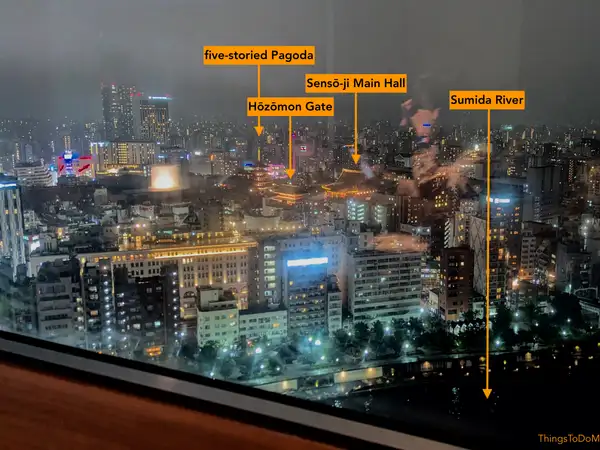
Asahi Sky Room: Great View of Asakusa and Tokyo Skytree
Japan, 〒130-0001 Tokyo, Sumida City, Azumabashi, 1 Chome−23−1 アサヒグループ本社ビル 22 階Essentials
- Phone
- +81 3-5608-5106
- Admission
- free
Opening times
Notes
Enter through the Asahi Headquarters (tall building), the Google Maps location is misleading.